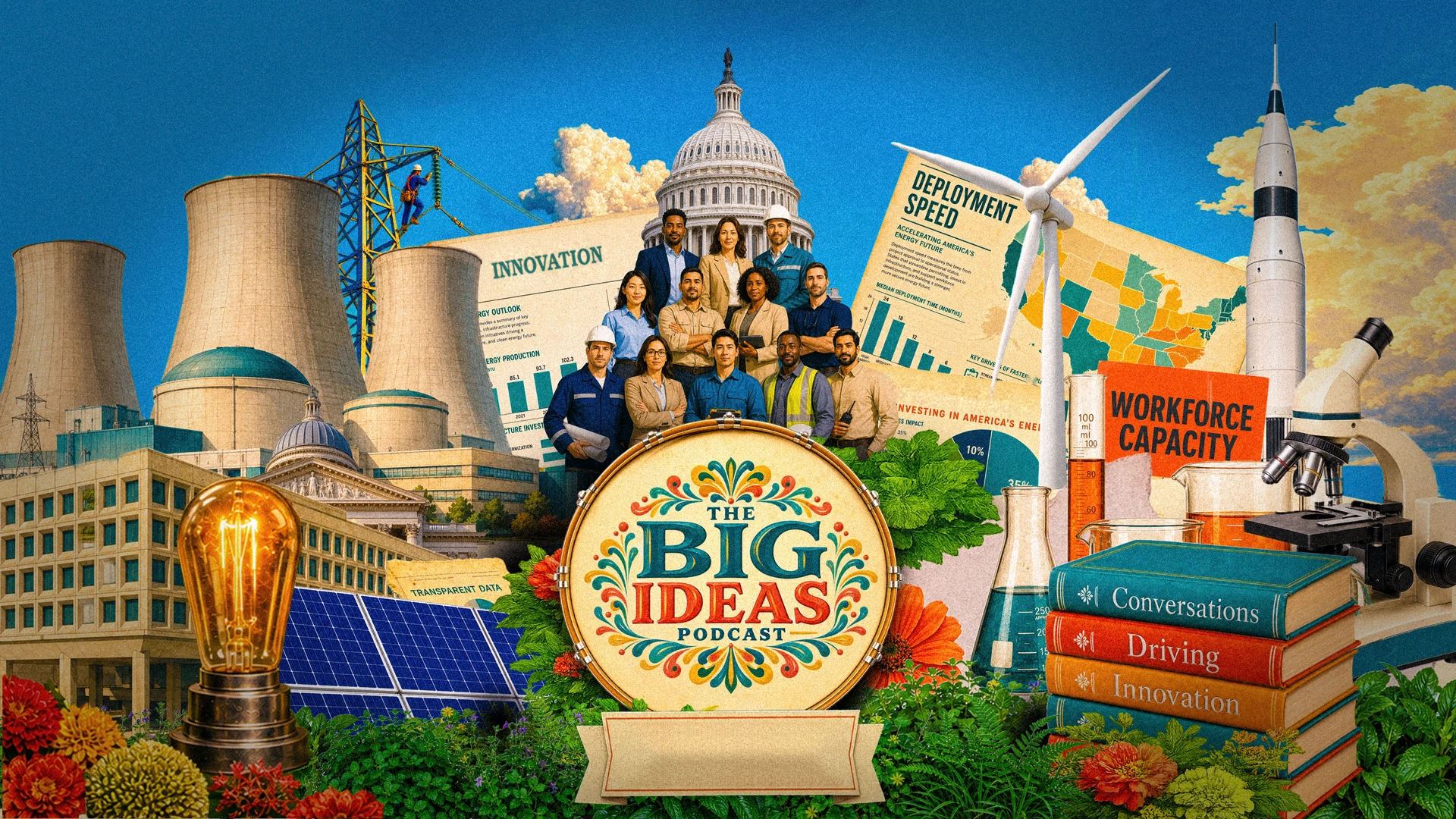
The United States is on a clean energy roller coaster. Policy fluctuates with every administration, research universities are under strain, and ongoing conflicts have destabilized global energy markets. This uncertainty keeps investors on the sidelines and slows American energy innovation. What will it take to get us back on track?
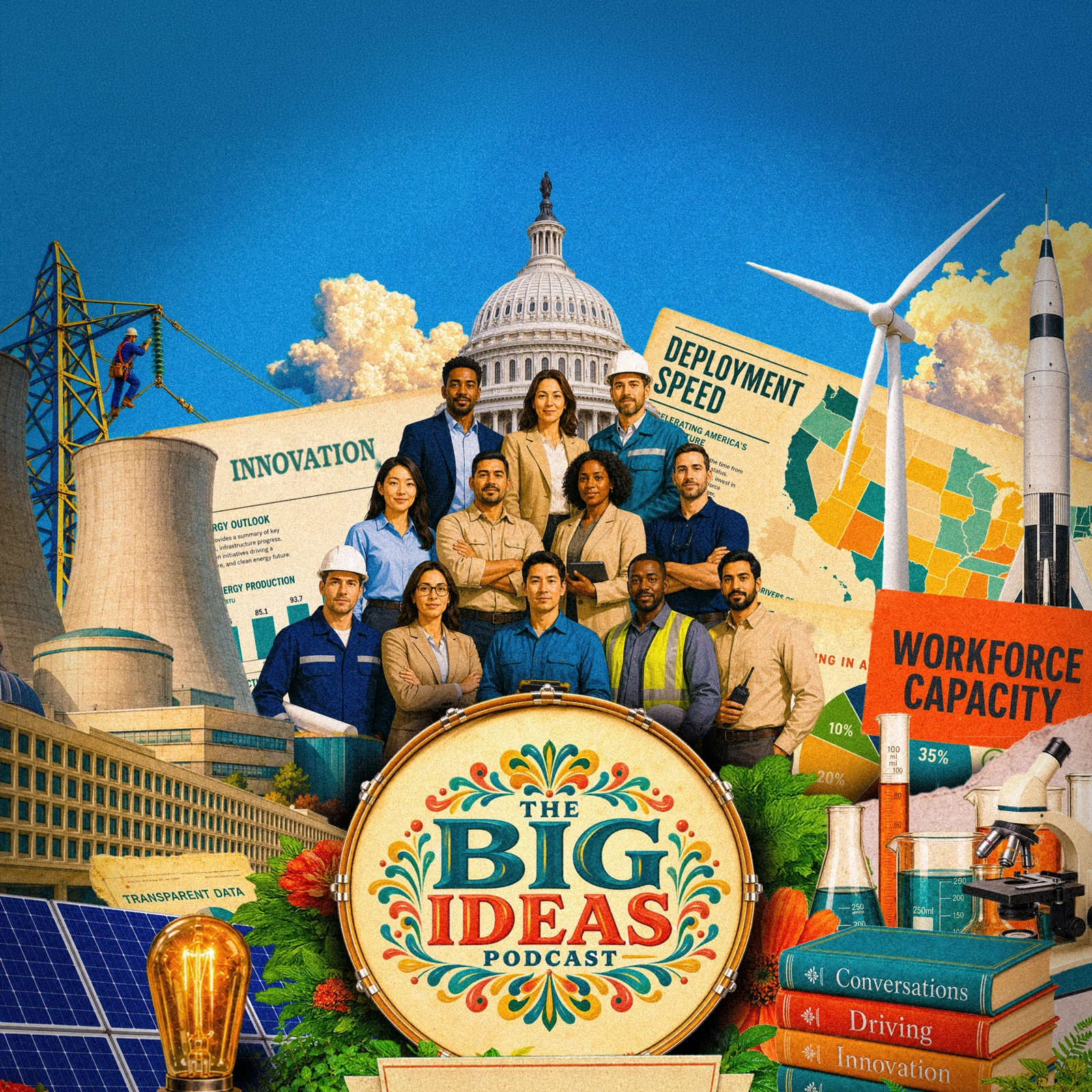
In the first episode of The Big Ideas Podcast, hosts Alex Kizer and Sarah Frances Smith sit down with Ernest J. Moniz, founder and CEO of the EFI Foundation and former U.S. energy secretary.
Moniz describes today as the most uncertain period for American energy innovation in his lifetime. He discusses why the United States and China approach innovation in opposite ways, the role of U.S. national laboratories in driving regional dynamism, and AI’s impact on energy and security.
Moniz’s Big Idea: Energy security, affordability, innovation, and equity must be viewed as one conversation.
Chapters:
- 0:00 Introduction
- 2:05 A Most Uncertain Era
- 3:36 United States vs. China
- 6:16 Moniz’s Big Idea
- 8:12 Energy Politics
- 12:03 Betting on Innovation
- 17:27: AI in Energy and Security
- 20:06 What Does AI Think?
Do you have a big idea? Share it here and our team will be in touch.
Follow us on Spotify, Apple Podcasts, and YouTube to keep up with the latest big ideas.



Episode Transcript
Episode Transcript
The Big Ideas Podcast: How Energy Innovation Works with Ernest J. Moniz
Hosts: Alex Kizer and Sarah Frances Smith. Guest: Ernest J. Moniz, Chairman and CEO, EFI Foundation; Former U.S. Secretary of Energy
[00:00] Alex Kizer: I’m Alex Kizer.
[00:01] Sarah Frances Smith: And I’m Sarah Frances Smith.
[00:02] Alex Kizer: And this is The Big Ideas Podcast from the EFI Foundation. This is our first episode.
[00:21] Alex Kizer: On this show, our friends and colleagues will join us to share their biggest and boldest ideas for addressing the energy sector’s greatest challenges.
[00:29] Alex Kizer: I’ve been doing this for about 20 years: at the U.S. Department of Energy, at the national laboratories, and here at EFI for the last nine years.
[00:36] Sarah Frances Smith: For me, my career so far has been defined by three pieces of landmark legislation: BIL, CHIPS, and the Inflation Reduction Act. I’ve spent a lot of time thinking about implementing all of that funding and asking myself: what can we do to help America get its competitive edge back?
[00:51] Alex Kizer: So why are we doing this show—other than, that I asked you to?
[00:54] Sarah Frances Smith: For the last two years at EFI, we’ve been assessing the health of the American energy innovation enterprise. It’s pretty clear from our work that we need new strategies and fresh ideas to help the United States better develop and deploy technology.
[01:09] Alex Kizer: Yes, and that’s why we launched the Energy Innovation Project last year, where we develop analysis, track data and create new metrics on the health and status of American energy innovation. What’s been missing are big ideas for addressing the biggest challenges: how to decarbonize, how to unlock investment, how to get job growth going. So we created a podcast.
[01:34] Sarah Frances Smith: Each episode, we’ll have one guest, who will come with their biggest and boldest ideas for fixing American energy innovation. So, who better for our first guest than Dr. Ernest Moniz, former U.S. Secretary of Energy, chairman and CEO of the EFI Foundation—and, also, our boss. Ernie has been a leading voice in energy innovation for a long time, from his days at MIT to leading the U.S. government’s basic research and science innovation enterprise. Ernie, welcome to the podcast.
Ernest J. Moniz: Thank you.
[02:05] Alex Kizer: We’ll get to your big idea in a second, but we want to start with some table-setting questions, because you’ve been at this for a long time. Is this the most uncertain period of your lifetime for American energy innovation?
[02:16] Ernest J. Moniz: I would say, yes. There have been unsettled innovation landscapes before, particularly when funding was tough. But today, it’s more than that. Overall, funding is there in both the public and private sectors, but it’s being constrained in strange ways. Key institutions are also under fire—research universities in particular—which have in many ways been the secret sauce of innovation for this country since World War II, especially in basic research, bringing together research and education.
We’re also on a climate and clean energy roller coaster. The roller coaster will go up again, and we’ll have another period like we had in the Biden administration, with all the tax incentives. But a lasting impact of this roller coaster is that it’s going to be a while until large parts of the private sector feel there’s enough certainty to make investments that can be sustained for a couple of decades, at least. And this uncertainty is, in itself, very corrosive to the innovation environment.
[03:35] Sarah Frances Smith: We often talk about how we’re losing our competitive edge in innovation and don’t know how to do industrial policy anymore. What does China know how to do that we don’t?
[03:44] Ernest J. Moniz: If you compare the United States and China, they come at the innovation problem in precisely opposite ways. The United States was built on a very strong foundation of fundamental research, which over time led to dramatic innovations. In contrast to China today, at least, those innovations produced not only new products, but new industries. That’s a distinguishing characteristic of that bottom-up approach. China, in a sense, started from industrial policy and is now trying to catch up on fundamental research.
I believe we need to do a good industrial policy. The trouble is that, historically, it has a mixed track record. So, implementation is critical, and that’s what we need to learn to do efficiently. China was very successful with its industrial policy in clean energy. Today, they dominate exports of solar panels, wind turbines, batteries, and electric vehicles. Soon, it will be hydrogen, since they’re committed to it. But I wouldn’t say they were terribly efficient at it. They used sledgehammers.
Alex Kizer: Brute force.
Ernest J. Moniz: Right. But it has certainly paid off in some ways. They also invest in R&D [research and development]. So, I think we’re all groping for the right way to get this whole end-to-end model done. It’s interesting that the United States and China started from different ends. Instead of ignoring each other, we could probably learn a lot from each other, in both directions.
[05:27] Alex Kizer: When you were secretary, sitting in that chair, how could you affect this dynamic system, practically, day to day?
[05:34] Ernest J. Moniz: When I was secretary, we forged a new relationship with the national laboratories. That was across DOE’s [the Department of Energy’s] mission space, but it was particularly important in energy. DOE has 17 national laboratories all over the country. They should be charged explicitly, in their contracts, with incentives to support regional innovation, because the clean energy space, as it evolves, is going to look very different in different regions of our country. Those labs treasure the word “national,” but I think they should be national and regional labs, especially in energy.
[06:15] Sarah Frances Smith: Ernie, is that your big idea, that the national labs should be regional innovation hubs? Or is there some other big idea?
Ernest J. Moniz: No, that’s just one idea.
Sarah Frances Smith: Do you have others?
[06:23] Ernest J. Moniz: The unfortunate recent events in Ukraine and in the Gulf have emphasized that clean energy and climate, security, and social equity must be viewed as one conversation, not separate ones.
But I do want to emphasize that innovation is more than just technology. It’s technology, it’s business models—very important, business models—and it’s policy. In the United States, we are strong in that order: strongest in technology and weakest in the policy innovation to match it.
Business model innovation is very critical, because science, innovation, and technology development are very much a cumulative enterprise. A lot of people say: wow, what a big breakthrough. We invented a new industry. That’s true, but what goes unrecognized is that the breakthrough came from accumulated developments, usually in many different areas, and somebody had a business model idea: these things are coming together now, and I can make a new business.
Just a couple of years ago, the Nobel Prize in physics was awarded for the early work that led to AI. John Hopfield of Princeton was one of the recipients for inventing the Hopfield neural network. When? 1982. It’s been 45 years since that fundamental work was done. And it’s not just the neural network, obviously. A lot of things have come together, including computational speeds many orders of magnitude greater since then. All of this comes together.
[08:11] Alex Kizer: To tease this out a bit more: I’m completely bought into the value of basic energy R&D and discovery. But as a follow-up to your first point about uncertainty: politics entering into energy is not new, but not knowing the destination is a hard sell. How do we hold all these elements together so we have a durable energy R&D framework, the basis of the innovation system we’ve relied on for so long?
[08:50] Ernest J. Moniz: If I go back to the 1980s, leading up to the Clean Air Act Amendments of 1990 that addressed acid rain, there was no material politics involved. The two major antagonists were from different parts of the Democratic distribution, because energy was a regional issue. One came from the Midwest and one from elsewhere—but it was really about New England and the Midwest with acid rain.
Alex Kizer: A historic rivalry.
Ernest J. Moniz: Yes, and the Midwest had to stop it, Alex. And they did.
Alex Kizer: The Rust Belt is what we used to call it.
Ernest J. Moniz: It’s what we still call it, actually, amazingly enough. But at that time, energy was more regional, and both political parties had very broad distributions. You had a number of Democrats to the right of some Republicans, and vice versa. Today, those distributions have tightened up very dramatically—especially for one of the parties—and things are much more black and white. That’s connected to the fact that energy is no longer quite the regional issue it was, in the sense that the political establishment has broken out along largely geographical lines. The two have morphed together, and over time that has amplified the roller coaster as political leadership changes.
The roller coaster contributes to a lot of investment uncertainty. If you look at the periods when President Trump has been in office, in both his first and second terms, frankly, I don’t see a lot of change in what multinational companies are actually doing. The language has certainly changed a lot in the second term, but I don’t see that big a difference in what they’re doing. The reason is that they work all over the world. That’s why they’re called multinational companies. You’ve got Europe with carbon border adjustments and carbon pricing, and the United States without it. You have emerging economies making low-carbon pledges but having a hard time getting there as they pursue economic development.
So, I think multinational companies are actually a stabilizing force. But now they’re having a hard time figuring out what’s going to happen with policy, with regulation, and with the risk-adjusted investment climate going forward. There’s a lot of money out there, but it’s a bit loath to go into the energy sector as aggressively as it might right now, as opposed to other sectors that are less prone to that oscillating behavior.
[12:01] Sarah Frances Smith: That leads me to another question: how do we know what to bet on in innovation? How does the private sector know what to bet on in basic research and early innovation? How does the government know what to bet on, and what should the interplay between them be?
[12:15] Ernest J. Moniz: First of all, companies would like to find investments that are as independent of policy changes as possible. A nice, secure investment: yes, I’ll take a few percent-lower return if I can have certainty.
But the other area where bets are well placed is exactly the areas that bring together different technology threads into a new business model. You need the technology innovation to be there. As I said, AI is a 45-year thing. Everybody thinks AI was somehow invented five years ago.
Alex Kizer: It feels that way, since you can’t avoid an app.
Ernest J. Moniz: Yes, because the big breakthrough has come.
Sarah Frances Smith: Or fusion. Would fusion also fit this category?
Ernest J. Moniz: Fusion may. It’s got to show that it can put electrons on the grid.
[13:09] Alex Kizer: I keep struggling with this, though. If it’s so tried and true that basic science leads to discovery that can then be adopted across the chain, how do we manage that with the need on the investment side for clear metrics, KPIs [key performance indicators], and outcome-based results? I understand how the two sides of the process interact, but when it’s unclear how one supports the other, how do we create more stability and durability so those opportunities keep getting created? That seems to be what gets whipsawed in this increasingly political process, and it seems like a really big issue.
[13:52] Ernest J. Moniz: Obviously, I would support getting this out of the political domain as much as possible. Eventually I think it will happen, but I don’t know when, and I don’t know how. Take climate, for example. Analogous to the acid rain example I mentioned earlier, I believe that when it’s time to have a national policy, it’s going to happen fast.
Let me add one more point in that acid rain context that I think is very important and goes to the innovation issue. I don’t think that negotiation would have happened the way it did at that time if not for the fact that, in parallel, the Department of Energy was supporting RD&D [research, development, and demonstration] on scrubbers. So when it came time to address the policy, the politicians knew roughly what it would cost, and that it could be done.
Alex Kizer: There was already a tool in the toolbox.
Ernest J. Moniz: Yes, you had the tool. I think the biggest bang for the buck in the near term is going to come from integrating the major platform technologies: AI, robotics, large-scale computation. Maybe quantum computing and quantum sensors will come along. As new business models are thought about—AI in the grid, for example, can transform the grid in ways that are only being nibbled at today. When that happens, you’ll see a flood of new ideas, new startup companies, new models, and new bets by venture capitalists. I think that’s where we’re going to go.
Going back to climate, I’ll add one more example. I think the transition will happen as weather continues to get more extreme. It’s not if, it’s when. It’s happening. It’s going to happen. Right, wrong, or indifferent, the public is increasingly associating warming with extreme weather. That’s going to provide the political pressure for politicians, as in 1990, to come together and say, “Okay, how are we going to do this?”
Alex Kizer: We’re already having wildfire smoke days, like snow days.
Ernest J. Moniz: Correct. And it’s not only the fires themselves. The smoke doesn’t exactly help solar radiation reach a panel, for example. There are all kinds of impacts. But the main thing is that extreme weather is costing a lot of money today, and it’s not always recognized. A lot of the increase in utility bills is coming from the adaptation utilities are having to do to keep providing reliable service. Not to mention the destruction of homes, lives lost, and so on. So, I think that political pressure will come, and that’s what will drive the politicians to the table.
[17:24] Sarah Frances Smith: Looking down the line, what do you think about AI’s ability to expand government capacity to forecast, deal with problems, and implement?
[17:34] Ernest J. Moniz: AI certainly has that potential. But as we all know, it also has risks: hallucinations and all kinds of things. Let me give you an example, one that will involve collaboration between the federal government and companies. AI clearly raises the level of risk from, say, cyberattack. But on the other hand, the only way to defeat it is through AI. So, my bots have to beat your bots. There’s going to have to be much more thinking along those lines. Some work is going on in some of the DOE laboratories, but it’s got to be realized soon.
Let me give you another example, not in the energy space. As you know, I also have a nuclear weapons portfolio, which also comes from the Department of Energy. Much is made of the fact that nuclear weapons use will always have what’s called a “human in the loop.” The final decision must be made by a human being, not by AI.
Alex Kizer: A lot of movies have been made on the premise of AI taking over nuclear weapons, leading to annihilation.
Ernest J. Moniz: Correct. And by policy, that’s not going to happen. However, for a long time I’ve been saying we shouldn’t feel very confident, because when the president is told, correctly or incorrectly—and up to now it’s always been incorrect—that there are 100 Russian missiles coming our way, and Mr. President or Madam President, you have 10 minutes to decide whether to launch, who’s going to prepare the briefing memo in a microsecond? AI. And I’m not sure that president isn’t even more constrained by having that briefing memo than without it.
Alex Kizer: The toothpaste is out of the tube.
Ernest J. Moniz: All I’m saying is that this is going to require some real, serious thought, because the unintended consequences of using such a powerful tool can be enormous. On the other hand, I don’t think we can walk away from that tool.
[20:05] Alex Kizer: You’ve set us up perfectly, because our last segment is about the AI bot we’re training on energy innovation. I’m about to ask our own AI tool what it thinks about your big idea.
Ernest J. Moniz: Should I duck?
Alex Kizer: You can brace for impact however you like. Okay, I’m going to ask it how to create durable, effective policy that treats security, climate, and affordability as one conversation rather than as trade-offs. And I told it the idea is coming from you, Secretary Ernest Moniz, just so you know.
All right, it says: “satisfying four masters can produce compromises that fully satisfy none of them,” Ernie. It also says, “this can be a euphemism for funding only what’s already broadly popular, quietly excluding investments that are necessary but genuinely contested.” I think it’s saying you’ll be master of none of those elements if we try to do all of them at the same time. Which feels like a tautology, but I’ll let you respond.
[21:13] Ernest J. Moniz: I would argue that’s exactly wrong. It’s only by addressing all of them that we’re going to make progress on all of them. We gave examples where addressing only one of them in isolation actually led to a retreat in other dimensions.
Alex Kizer: Well, we can use that to train our model a bit more. There we have it: one conversation, Ernie’s one big idea.
Ernest J. Moniz: Okay. Better train the model some more [laughs].
Ernest J. Moniz: We’ll make the AI listen to this podcast, and we’ll come back and give you an updated answer.
Sarah Frances Smith: That’s the loop. Nonlinear feedback loops.
Sarsh: That’s right. Ernie, thanks for being our first guest.
Ernest J. Moniz: Thank you.
[21:59] Sarah Frances Smith: This was fantastic. If something you heard today sparked a big idea of your own, we want to hear it. Drop us a line at the email in the podcast notes.
Alex Kizer: If you have a big idea, let’s hear it.
The Energy Innovation Project
How we’re tracking implementation at DOE
The Big Ideas Podcast
Big ideas for energy innovation