
Building Demand for Low-Carbon Concrete: How Public and Private Procurement Can Unlock a Market (March 2026) recommends a pragmatic, low-cost action plan to reduce concrete’s carbon intensity by leveraging the market-forming power of demand-side policy.
Concrete is second only to water as the most widely used material on Earth. Global demand is expected to grow more than 40% by midcentury, driven by population growth and industrialization. Today, concrete production accounts for 8% of global greenhouse gas emissions. If it were a country, it would be the world’s fourth largest emitter.
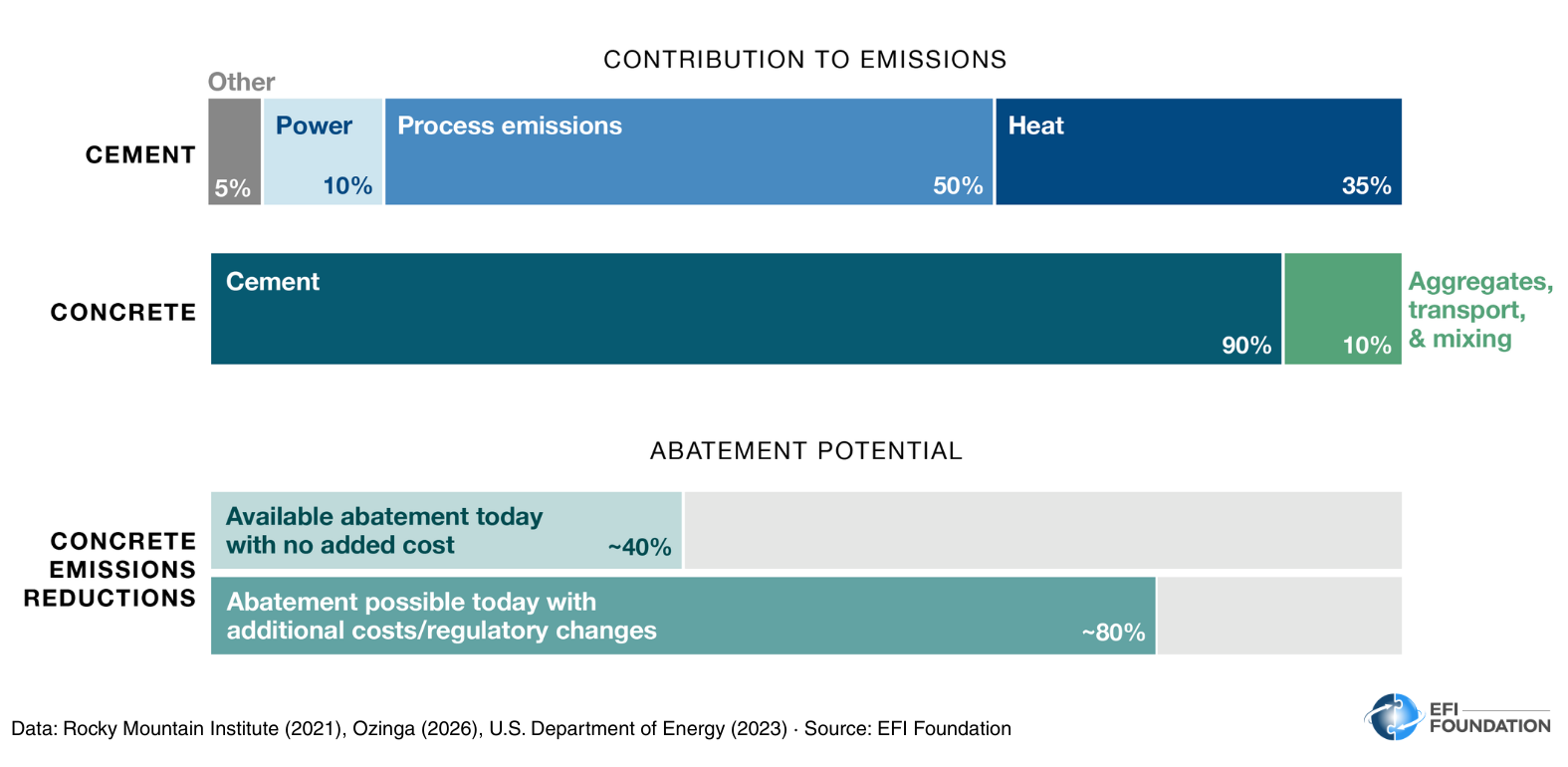
Concrete is composed of water, sand, aggregates, and cement. Cement typically represents less than 15% of the average concrete mixture by mass, but accounts for 90% of its emissions. Cutting emissions from cement is essential to decarbonizing concrete production. Fortunately, cost-effective pathways for producing low-emission, high-performing concrete and cement mixtures are already in use today. Figure 2 details the emissions profile of cement and concrete, and the abatement potential of existing mixtures.
Figure 2. Concrete and cement GHG emissions and present-day cost-effective
abatement potential
However, despite the cost competitiveness and proven performance of lower-carbon mixtures, the market for low-carbon concrete has been slow to scale. This is largely due to market and policy impediments, including a lack of market transparency, reliance on outdated standards and specifications, and a fragmented value chain that dulls market signals.
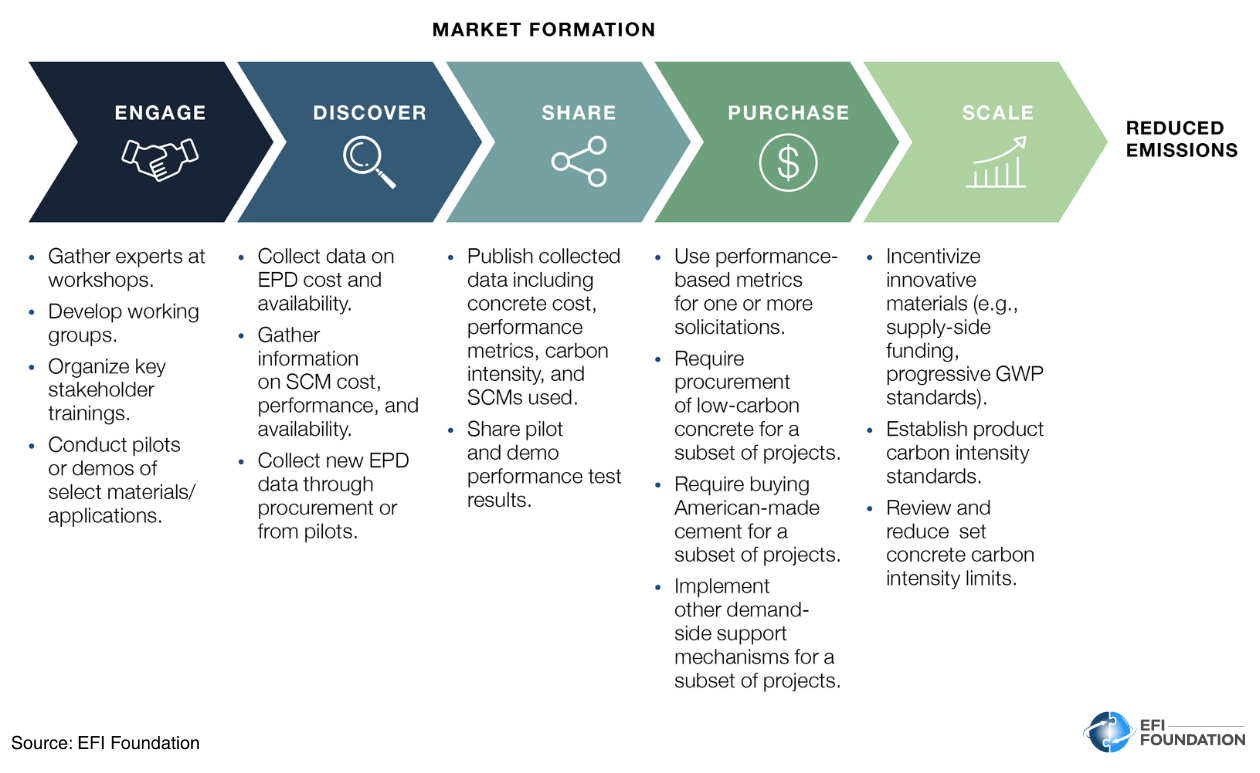
The EFI Foundation proposes a Market-Forming Demand Action Plan to unlock the market-making power of public and private procurement and accelerate market growth for low-carbon concrete. This plan consists of the following phases (see Figure 10):
- Engage stakeholders to build working relationships, test ideas, and conduct trainings and pilot projects.
- Discover relevant market and product information.
- Share market and product data, insights from working group engagements, and pilot projects.
- Purchase low-carbon concrete with large-volume commitments.
- Scale actions to reduce carbon intensity, including support for innovative material development and progressive reductions of concrete carbon intensity thresholds.
Figure 10. Market-Forming Demand Action Plan for public and private sector purchasers of concrete
The report surveys existing state and local policies supporting low-carbon concrete and recommends demand-side actions to expand the low-carbon concrete market. The analysis demonstrates that, with the right demand-side tools in place, concrete can be decarbonized at minimal additional cost.