
Authors
EFI Foundation: Alex Kizer, Michael Downey, Rachel Holzer, Katelyn O’Dell Dean
Hamm Institute: Katie Altshuler, Jason Angolano
DMH Policy Advisors: David Hart
Scaling a new energy technology from an early demonstration into a successful commercial industry requires access to affordable capital, a diverse array of customers, robust supply chains, and a pipeline of repeatable projects.
Next-generation geothermal, which uses various technologies to engineer geothermal resources for power generation across different geographies, is seeking to scale from demonstration to widespread deployment at a crucial moment. For the first time in decades, demand for electricity is booming in the United States. That growth is driving a major buildout of new generation and creating opportunities for emerging technologies that have historically occupied narrow niches. The U.S. Department of Energy (DOE) estimates that geothermal resources could provide 90 gigawatts (GW) to 132 GW of U.S. electricity generation capacity by 2050, up from just 3.7 GW in 2024.
There are already signs of that progress. For example, Fervo Energy’s Cape Station project in Utah delivered first power to the electric grid in September 2026, making it the first enhanced geothermal system in the United States to reach commercial operation. Cape Station has attracted considerable attention, reflecting both the project’s significance and the industry’s early stage of development. The industry’s next opportunity is to build on that success by having more companies deploy more projects in more places.
The EFI Foundation (EFIF) and the Hamm Institute for American Energy at Oklahoma State University are partnering to better understand the conditions that will foster sustained growth and a diverse portfolio of successful projects in the next-generation geothermal industry. To build this understanding, we are conducting interviews with industry players; hosting convenings to bring together government, industry, and the finance community; and leveraging our respective expertise in subsurface industries and federal program design. Our focus is on federal enablement of geothermal market formation, complementing work already underway at the state and regional levels.
Here, we are sharing early insights from our work thus far. After over 30 interviews with developers, investors, utilities, policymakers, and other industry players, we have identified a few consistent themes on the challenges the geothermal industry is currently facing. However, these conversations have also revealed diverging perspectives on which challenges are most significant and how they should be addressed. Ultimately, through this work, we aim to uncover a clearer picture of where the industry stands today, what is limiting its growth, and where federal agencies can play a constructive role as the market develops.
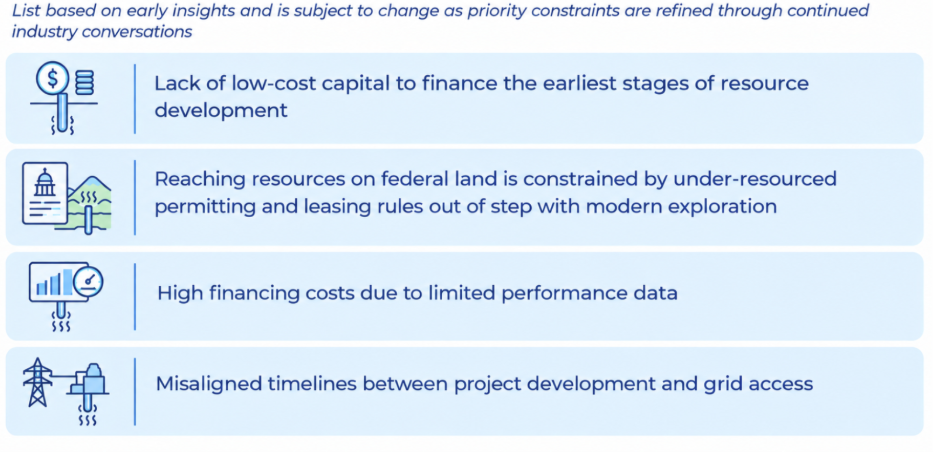
Figure 1. Constraints interviewees commonly identified as holding back next-generation geothermal deployment
Source: EFI Foundation.
Next-Generation Geothermal Today
In recent years, the geothermal industry has seen an influx of private capital (especially for later-stage projects), early offtake agreements, and bipartisan backing for the industry’s growth. But much-needed support for the early development of a technologically and geographically diverse portfolio remains out of reach.
Between 2021 and 2025, next-generation geothermal companies raised more than $1.5 billion in private capital, including $473 million in debt financing, a sign that lenders increasingly view the technology as bankable. Funding further accelerated in 2026. Industry leader Fervo Energy raised $2.2 billion in equity through an initial public offering and a $421 million debt financing package for its first commercial-scale project. Quaise Energy, Sage Geosystems, and Zanskar are among the other next-generation geothermal startups that together have raised $432 million this year.
The sole enhanced geothermal systems (EGS) company to reach commercial operation to date, Fervo Energy, has charted an encouraging path forward. Fervo reports a 70% reduction in drilling time and a nearly 50% decline in drilling costs, slashing one of the biggest items on the geothermal expense ledger. The efficiency gains are translating into promising economics. Fervo built the first phase of Cape Station at roughly $7 million per megawatt (MW), is targeting $5.5 million for the second phase, and aims for $3 million over time, compared with $2.16 million per MW for a new combined-cycle gas plant. Natural gas has a lower upfront capital cost, but that figure excludes the fuel the plant must buy over decades, so the delivered cost is much closer. Lazard’s 2026 analysis puts unsubsidized geothermal at $67 to $111 per megawatt-hour (MWh) and gas combined-cycle power at $51 to $129 per MWh.
Utilities and large electricity users, including data centers, are beginning to sign agreements to buy power from next-generation geothermal projects. Between 2021 and the first half of 2025, buyers signed 12 agreements, totaling just over 1 GW, for power offtake from next‑generation geothermal projects. In April 2026, XGS Energy and California Community Power signed a development agreement for 115 megawatts (MW). And in September, Fervo and Google signed the world’s largest enhanced geothermal power purchase agreement for 396 MW with an option to expand by 600 MW, totaling nearly 1 GW by 2030.
These deals show that private capital and offtake agreements are available for some geothermal companies and projects, but primarily at more advanced stages of development. Early resource development, required for a diverse project portfolio, remains difficult to finance.
Support for next-generation geothermal spans across the aisle and across states. Energy Secretary Chris Wright believes that next-generation geothermal power “could help enable AI, manufacturing, reshoring, and stop the rise of our electricity prices.” Congressional Republicans preserved geothermal tax credits enacted under the Biden administration, even as they sharply scaled back those for wind and solar. The Republican and Democratic governors of Arizona, Colorado, New Mexico, and Utah recently joined as the founding members of the Mountain West Geothermal Consortium, which aims to connect policymakers, developers, and investors to scale responsible geothermal energy.
A Brief History of Federally Supported Innovation in Geothermal
DOE support for geothermal development has a long history. As the industry evolves to tackle new challenges across the research, development, demonstration, and deployment pipeline, federal policy should evolve as well.
The development of next-generation geothermal has been decades in the making. While the oldest geothermal power systems date back to the early 1900s, more recent technological breakthroughs enable the creation of accessible geothermal resources in many places, not just in a few hot spots. DOE has funded geothermal research and development since the 1980s, with dedicated next-generation support beginning in 1992. While steady, funding remains an order of magnitude below that for comparable clean, firm technologies such as nuclear energy (Figure 2).
Figure 2 Appropriations to DOE for geothermal and nuclear energy, fiscal years 2011 to 2026
Historically, DOE’s core role in geothermal development has been research and demonstration: paying for early, high-risk science that firms cannot easily finance on their own and making the results public. Its largest investment is the Frontier Observatory for Research in Geothermal Energy (FORGE), a field laboratory near Milford, Utah where scientists drill test wells to develop enhanced geothermal techniques and publish their findings. FORGE has been backed by nearly $300 million in federal investment since 2014.i
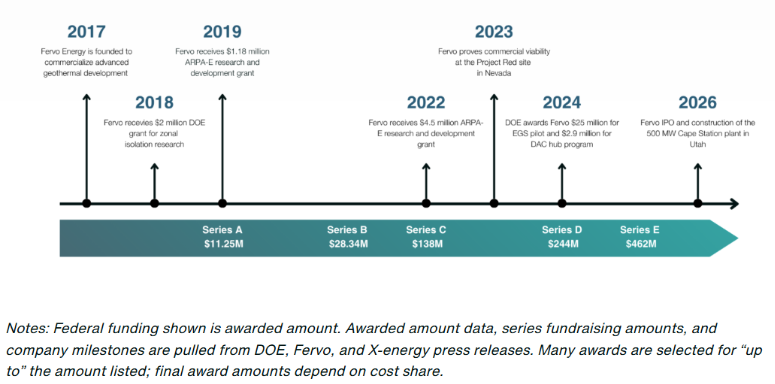
DOE also supports companies working to turn basic research into commercial products. Most prominently, Fervo received at least six DOE awards totaling $35.6 million between 2018 and 2024 as it developed its technology (EFIF’s Energy Innovation Project documented federal support on Fervo’s path to initial public offering). Siting its first commercial scale project on land adjacent to FORGE allowed Fervo to exploit preexisting federal geological data, reducing subsurface and exploration risks. Other developers have drawn on the same programs. Mazama Energy, for instance, won an $18 million DOE pilot demonstration award to test enhanced geothermal in the superhot rock—rock heated to 400 degrees Celsius or above—beneath Oregon’s Newberry Volcano.
Figure 3. Fervo’s lab-to-market timeline
Source: EFI Foundation.
Today, DOE has 76 active geothermal awards worth $667 million, according to EFIF’s Energy Innovation Project database. In September 2026, DOE selected 21 projects to receive $99 million for field tests and resource confirmation drilling, including field-scale EGS demonstrations by Fervo, Quaise, and Zanskar. The resulting data was published openly through the department’s Geothermal Data Repository.
EFIF estimates that DOE has an additional $30 million in funding for enhanced geothermal pilots that does not expire under the 2021 Infrastructure Investment and Jobs Act, although DOE may use those funds for its 2026 funding opportunity announcement to support field tests for resource characterization and confirmation. In addition, DOE has approximately $154 billion in Section 1706 loan authority that expires after September 2028, as well as $36 billion in Section 1703 Innovative Energy and Supply Chain loan authority that could be used for geothermal, which does not expire.
Investigating Potential Barriers to Further Progress
Tracking DOE’s past and current funding for the geothermal sector is only one piece of the puzzle. Scaling the industry will require policy that spans multiple agencies. As a starting point, EFIF and the Hamm Institute’s interviews with industry players have pointed to several potential challenges. We are actively working to find consensus among experts on the relative importance of these issues and the appropriate policy response. Four areas have emerged as priorities for further investigation.
Lack of low-cost capital to finance the earliest stages of resource development: Before building a power plant, developers must find where to drill to extract heat economically, a discovery process called appraisal drilling, which comes after promising exploration drilling and is often expensive and risky. If the heat is not there, the driller gets nothing back. Conventional project finance is poorly suited to this kind of early, binary risk.
Permitting and leasing on federal land have not kept pace with the industry’s needs: Much of the best resource sits under federal land, yet interviewees report that the Bureau of Land Management (BLM) lacks the dedicated staff and funding for geothermal permitting that it has long had for oil and gas. BLM permitted only a few dozen wells in 2025, compared with the thousands that scaled deployment would require. The leasing rules add friction too, from parcels too small for large projects to a competitive bid structure that can leave first movers who located a resource exposed to being outbid. The Senate’s bipartisan permitting bill, introduced in September 2026, leaves the competitive bid structure unchanged but would extend the National Environmental Policy Act treatment oil and gas receive to geothermal, require annual lease sales, set deadlines for drilling permit decisions, and authorize cost recovery for permit processing.
High financing costs due to limited performance data: Next-generation plants require a decade or more to recoup their upfront costs. Investors need evidence for how wells will perform over that period, but the industry is too young to provide much real-world data. Developers cannot yet show how reservoirs cool, how flow rates decline, or how to space well pairs for durable output. Available technical evidence supports the technology, but investors still charge a premium to account for the risk of underperformance.
Misaligned timelines between project development and grid access: Many prime sites sit far from existing transmission, and the process of building new lines is slow and uncertain. Developers must often make major capital commitments before fully appraising a resource and before interconnection costs and timelines are known, making otherwise bankable projects difficult to advance.
How Can Federal Policy Help Spur Deployment?
EFIF and the Hamm Institute are working closely with industry and government partners to investigate how future federal geothermal policy could best address current industry constraints. States and localities are already developing policies to support next-generation geothermal. The future role of federal support must be defined.
A few broad principles will guide this process. First, federal policies should complement those of other levels of government while using tools that are uniquely available to the federal government, especially for managing risk and accessing public lands. Second, the policy environment as a whole should “crowd in” private investment; many specific policies should eventually be phased out as investor confidence solidifies. Finally, the framework should be flexible enough to adapt as developers gain experience and the technology changes.
Next-generation geothermal is now entering commercial deployment, but the developers, investors, and utilities we interviewed point to constraints in financing, permitting, performance data, and grid access. Identifying a federal role that could address those bottlenecks without substituting for the private investment and state-level activity will be indispensable in scaling the geothermal industry for years to come.
[1] DOE selected the University of Utah for the FORGE site with up to $140 million; the project’s budget reached $218 million through mid-2024, and DOE approved an additional $80 million extension for 2024 to 2028.
Learn how we’re tracking implementation at the DOE:
Explore the Energy Innovation Project