
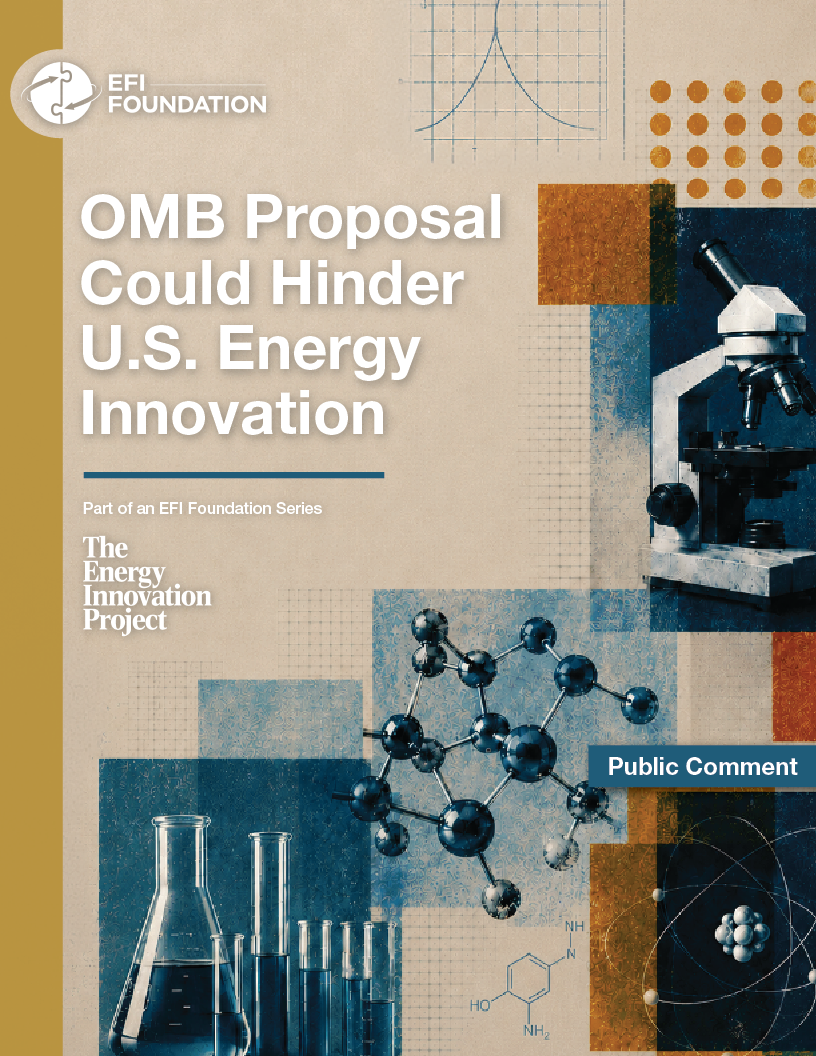
OMB Proposal Could Hinder U.S. Energy Innovation (July 2026) is a public comment on proposed changes from the Office of Management and Budget (OMB) to the Uniform Guidance, which governs how federal agencies award and administer grants and cooperative agreements. These changes have implications for the ability of the U.S. Department of Energy (DOE) to fund research and development across basic science, applied energy research, technology demonstration, and commercialization.
The paper examines three proposed changes from OMB which may have the largest impact on DOE grants and cooperative agreements:
- A requirement that senior political appointees review discretionary financial assistance awards before issuance.
- Expanded restrictions on federally funded collaboration with countries considered foreign adversaries, such as China.
- Constraints on allowable costs, including publication expenses and conference participation.
Appointee screening of new awards would insert a mandatory political approval step above DOE’s existing review process. Questions arise concerning the qualifications of political appointees to make such reviews, the administrative burden it imposes on DOE, and how the process could narrow the scope of innovation, particularly for smaller institutions.
The proposed rule would also establish strict prohibitions on recipients and subrecipients from using federal funds for collaboration with foreign entities including China, Russia, Iran, and North Korea. The prohibition applies not only to direct research costs, but indirect costs that might be allocable across a broad research portfolio. The analysis shows that eight of the 10 universities receiving the most DOE funding since fiscal year 2017 would be adversely impacted by this proposal.
The restriction on allowable costs for disseminating research results would disallow awardees from using federal grant funds for publication, conference presentations, and other common methods of communicating findings. There are narrow exceptions requiring a case-by-case agency review, which imposes further administrative burdens on awardees and agencies.
The public comment period closes on Monday, July 13, 2026. More than 300 research organizations have requested an extension of the comment period, arguing the rule’s breadth calls for more than the standard 45-day window.
Universities, national laboratories, nonprofits, and other organizations that receive or anticipate applying for DOE funding are financially tied to how these rules are designed. The record developed during the comment period will shape the final rule. The EFI Foundation will continue to monitor this rulemaking and its implications for DOE’s research enterprise.
Learn how we’re tracking implementation at the DOE:
Explore the Energy Innovation Project