
By Sarah Frances Smith
In the last month, two clean firm power companies debuted on the public markets amid policy uncertainty, rising energy costs, and an unprecedented global oil supply crunch. Fervo Energy (newly minted as “FRVO”) became the first next-generation geothermal company to go public, and X-energy (“XE”) delivered the largest public-market debut for advanced nuclear to date.
These IPOs generated excitement across the climate tech world. In a period when the future of many low-carbon technologies remains tenuous, such as the stalled direct air capture industry, Fervo and X-energy emerged as success stories with their upsized IPOs.
There’s no doubt that competitively scaling firm power capacity—a stated priority of the Trump administration—requires more than just private capital. Bringing promising energy technologies from the lab to commercial scale depends on early federal investment and stable institutional support.
But how much federal support, exactly? The EFI Foundation (EFIF) built the Energy Innovation Project—a platform designed to navigate federal data and uncover how U.S. Department of Energy (DOE) funding translates into impact—to help answer that question. Using the platform’s federal funding database, users can trace the specific DOE awards that supported Fervo and X-energy and explore what their trajectories reveal about scaling the next generation of energy technologies.
DOE Awards to Fervo Energy and X-energy
| Program Name | Awarded year | Awarded funding | Obligated funding | Outlaid funding |
|---|---|---|---|---|
| Fervo | ||||
| Zonal isolation research grantiFAIN: DEEE0008486 | 2018 | $2 million | $1.02 million | $0.77 million |
| ARPA-E grantiiFAIN: DEAR0001153 | 2019 | $1.18 million | $1.18 million | $0.93 million |
| Project grantiiiFAIN: DESC0020823 | 2020 | $0.2 million | $0.2 million | $0.2 million |
| ARPA-E grantivFAIN: DEAR0001604 | 2022 | $4.5 million | $4.0 million | $3.39 million |
| EGS pilot demonstrationsvFAIN: DEEE0011277 | 2024 | $25 million | $22 million | $3.32 million |
| DAC Hub awardviFAIN: DEFE0032384 | 2024 | $2.87 million | $2.86 million | $0.6 million |
| Fervo total | $35.6 million | $31.2 million | $9.26 million | |
| X-energy | ||||
| Advanced reactor awardviiFAIN: DENE0008472 | 2016 | $40 million | $25.5 million | $5.4 million |
| Industry FOA, 2018 1st roundviiiFAIN: DENE0008745 | 2018 | $4.5 million | $18.6 million | $10.1 million |
| Industry FOA, 2019 4th roundixFAIN: DENE0008931 | 2020 | $3.5 million | $3.0 million | $0.62 million |
| ARPA-E awardxFAIN: DEAR0001292 | 2020 | $5.3 million | $5.25 million | $5.25 million |
| ARDP awardxiFAIN: DENE0009040 | 2020 | $1.23 billion | $922 million | $502 million |
| Industry FOA, 2022 1st roundxiiFAIN: DENE0009434 | 2023 | $2.5 million | $1.71 million | $1.6 million |
| X-energy total | $1.28 billion | $971 million | $525 million | |
Notes: Awarded amount data is pulled from DOE, Fervo, and X-energy press releases. Many awards are selected for “up to” the amount listed; final award amounts depend on cost share. Obligated and outlaid data is from USAspending.gov as of May 19, 2026. Fervo also received funding for work on zonal isolation and through DOE’s Frontier Observatory for Research in Geothermal Energy (FORGE), which is a subgrant and not reflected here.
Table 1 shows DOE will invest up to $35.6 million in Fervo’s projects and up to $1.28 billion in X-energy’s. Both companies received multiple awards, of varying magnitudes and structures, across multiple years. This list does not include any federal tax credits or non-DOE awards, though the resilience and stability of tax credits for nuclear and geothermal have certainly played a role in the scaling of both Fervo and X-energy.
DOE supported both companies throughout their technology scaling. In addition to receiving funds relatively early in their development, both Fervo and X-energy received multiple awards throughout the scaling process, often referred to as the “missing middle” of project financing. During this period, funding needs increase significantly as projects reach commercial scale.
X-energy and Fervo’s Lab to Market Timelines
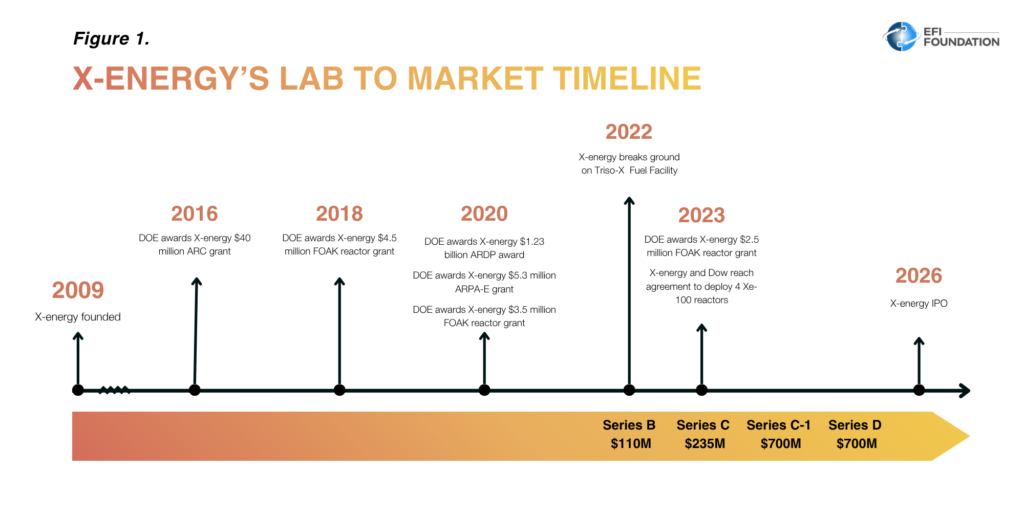
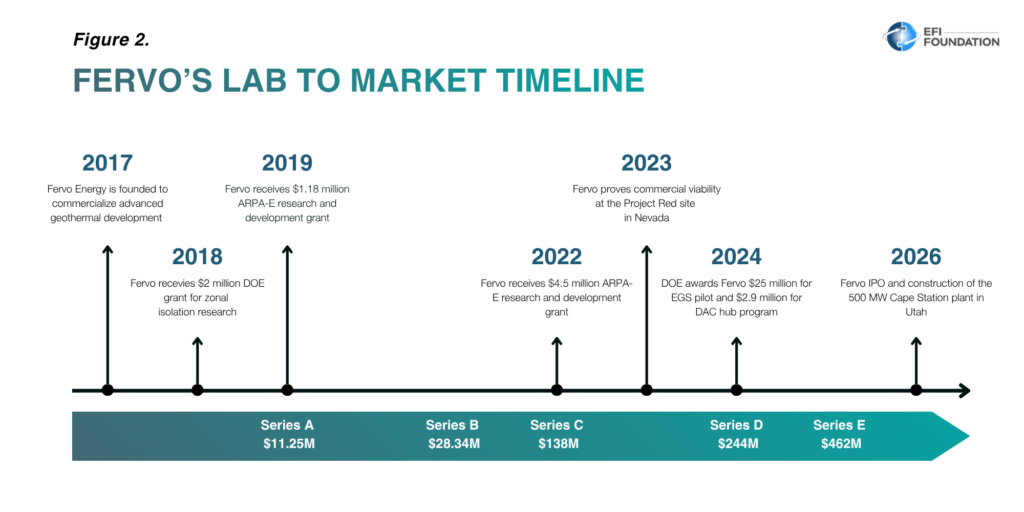
Notes: Federal funding shown is awarded amount. Awarded amount data, series fundraising amounts, and company milestones are pulled from DOE, Fervo, and X-energy press releases. Many awards are selected for “up to” the amount listed; final award amounts depend on cost share.
DOE funding and partnership remains critical to Fervo and X-energy as they continue through commercial growth. The department’s Office of Nuclear Energy (NE) and Office of Hydrocarbons and Geothermal Energy (HGEO) will manage ongoing awards to X-energy and Fervo, respectively. The administration has indicated that it will prioritize deployment of baseload power technologies, and the FY27 budget request shows a 27% increase in staff for NE next year and a 16% increase for HGEO.1 The past four years of the implementation of the Bipartisan Infrastructure Law and the Inflation Reduction Act have taught us that DOE’s ability to efficiently move funding from appropriation to implementation relies on adequately staffed offices with the appropriate expertise (see EFIF’s prior work on DOE’s staff-to-budget ratio).
Current and Planned Staff Counts at DOE’s Nuclear and Geothermal Offices
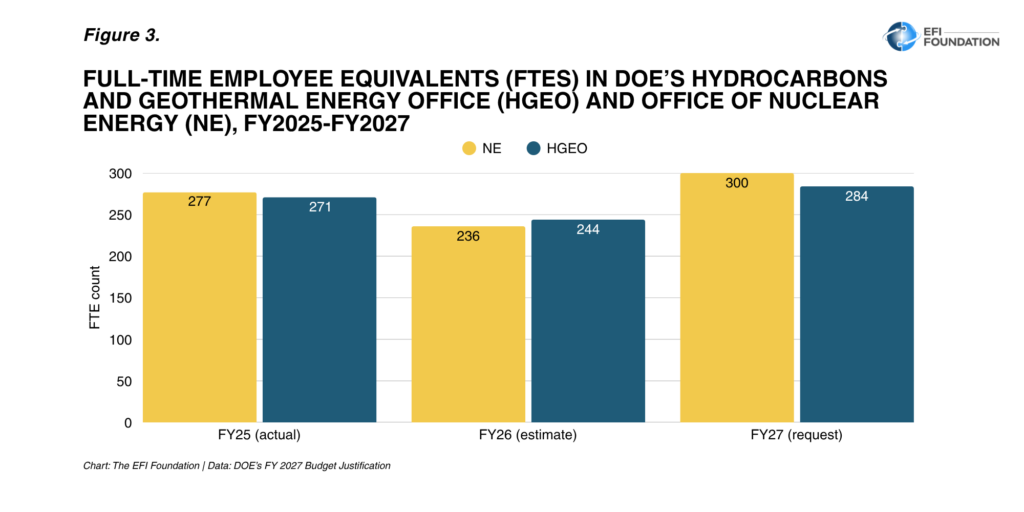
While planning to increase staff, the administration requested less funding for both the nuclear energy and geothermal offices for FY27. The extent to which Congress will fulfill this request remains to be seen, as does the administration’s willingness to fund future baseload power deployment.
There’s no doubt that it is an exciting time for scaling nuclear power and geothermal energy in the United States, though there remains significant work to do. There are 25 geothermal and 19 nuclear bills working their way through Congress, signaling bipartisan support for tackling tricky issues such as permitting and financing.2 Companies scaling technologies in both sectors require sustained federal support throughout their development, as illustrated by Fervo and X-energy. Strong public-private partnerships can be catalysts of American energy innovation, built on federal funding designed to help innovators attract private financing while navigating the permitting, grid interconnection, technology licensing, and project development challenges that often hinder commercialization. As documented by the Energy Innovation Project, this type of federal support is a common marker for energy technologies that successfully navigated across all “valleys of death.”
Learn how we’re tracking implementation at the DOE:
Explore the Energy Innovation Project