
Author: Rachel Holzer
Contributors: Alex Kizer, Sarah Frances Smith, Katelyn O’Dell Dean
The Infrastructure Investment and Jobs Act (IIJA) is the largest federal investment in American energy infrastructure and innovation in generations. Through the IIJA, Congress authorized the Department of Energy (DOE) to award $57.5 billion to strengthen the nation’s energy systems, expand domestic manufacturing, demonstrate emerging technologies, and accelerate deployment of technologies with the potential to reshape the U.S. energy landscape.
However, nearly five years after IIJA became law, only $3.7 billion (6%) of the funding Congress authorized for DOE has reached recipients, also called “outlayed.” Over half, $29.3 billion, of the IIJA funding has yet to be legally committed to a recipient, “unobligated,” including $15.5 billion that has not been touched since the law was enacted. Understanding where IIJA money stands is essential to assessing the progress of the investment Congress authorized and the potential that remains to be realized.
DOE’s remaining IIJA funds do not expire. The Trump administration has over two years to continue obligating the remaining $29.3 billion, including by entering into final agreements with awardees currently in the selection phase ($12.6 billion). The lack of expiration date does not, however, insulate the funds from future congressional action. In fact, in 2026, Congress repurposed $5.2 billion of IIJA funds. Anything the current administration does not obligate, and Congress does not rescind or repurpose, will be inherited by the next administration.
Unobligated Funds Represent Opportunities to Advance American Energy
Congress’s decision to redirect some unobligated IIJA funds reflects the slow pace at which DOE has put those resources to use. In the four years before IIJA’s enactment, DOE obligated an average of 74% of its total budgetary resources each year; that rate fell to 32% in fiscal years 2022 through 2025. EFIF’s Modernizing American Energy Innovation report (June 2025) found that during the Biden administration, DOE’s staffing and contracting processes had not scaled to the size of the IIJA investment, slowing the pace of funding. The mismatch between award practices designed for research grants and the demands of large capital demonstration projects also created friction in the awards process. Going from solicitation to award took an average of 18 months, while negotiations sometimes extended three years beyond the award decision.
Since January 2025, the Trump administration has shifted DOE’s priorities and the pace of funding has slowed even further, although DOE still has time to accelerate execution before 2029.
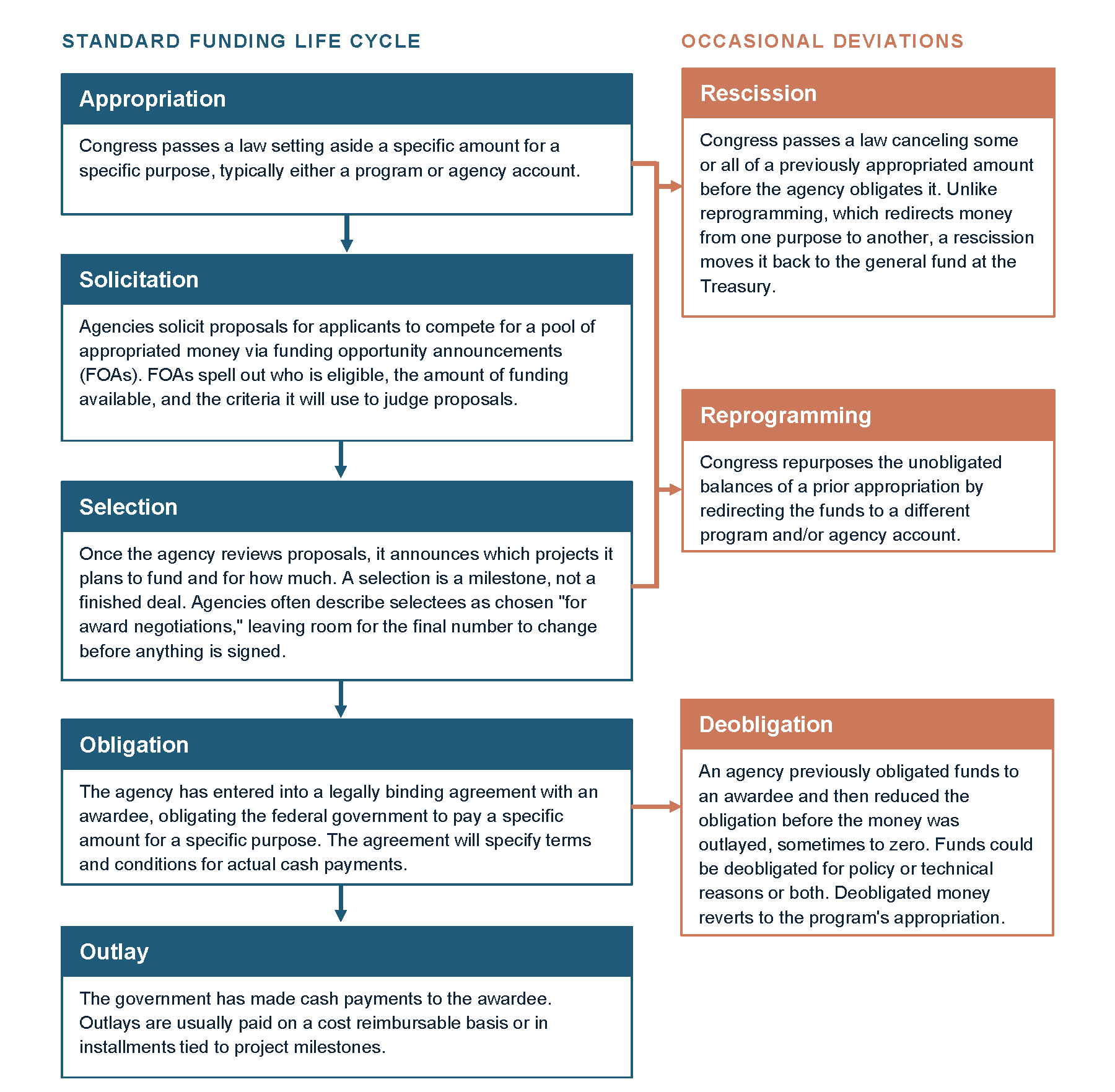
To reprogram DOE appropriations, Congress is required to pass new legislation that repurposes unobligated balances from one IIJA section—either a specific program or an account—and make those funds available for a different program or account, typically via an appropriations bill.i Otherwise, DOE can only use the funds for the statutory purposes described in IIJA. Obligated funds generally cannot be treated as available balances for reprogramming or rescission because they are already legally committed to existing awards.
In its fiscal year (FY) 2027 budget request, DOE asked Congress to rescind $15.2 billion in IIJA funds, primarily from the Offices of Energy Efficiency and Renewable Energy, Clean Energy Demonstrations, and Fossil Energy and Carbon Management. Congress has not yet acted on that request.
To date, congressional action has focused on shuffling IIJA funds within DOE rather than broadly unwinding the law’s energy innovation investments. However, the $5.2 billion that Congress reprogrammed in FY2026 shows that unobligated funds can become a source of funding for other priorities, as shown in Figure 2. The longer large balances remain unused, the more opportunity there is for Congress to reconsider how those funds are spent, particularly as budget pressures create incentives to repurpose or rescind unobligated funding.
Those fiscal constraints are becoming more pronounced as the federal government faces large deficits, rising debt, and increasing interest payments. Gross federal debt passed $40 trillion in August 2026, and the portion held by the public reached $32.3 trillion. The Congressional Budget Office projects a $1.9 trillion deficit for FY2026, equal to 5.8% of GDP, with net interest payments on the debt exceeding $1 trillion per year. As deficits and debt service grow, unobligated IIJA balances may face greater scrutiny and increased risk of being repurposed or rescinded.
In the FY2026 reprogramming, Nuclear Energy and EERE received the two largest amounts, $3.2 billion and $1.15 billion, but both funded part of that gain through cuts to other programs within their own accounts, $1.28 billion and $393 million respectively.
The Office of Nuclear Energy’s $3.2 billion is for the Advanced Reactor Deployment Program and up to two new Generation III+ small modular reactor awards, major priority areas for the Trump administration. Therefore, DOE will likely move swiftly to obligate the funds.ii The Office of Grid Deployment received $375 million to expand the domestic supply chain for grid components. The remaining $1.69 billion supplemented FY2026 appropriations across five offices: $1.2 billion for EERE, $150 million for the Title 17 Loan Guarantee Program (to be used for program administration and credit subsidy, not loan authority), $150 million for Science, $140 million for Fossil Energy, and $100 million for Nuclear Energy.
The programs that lost funding in this reshuffle were the Civil Nuclear Credit Program ($1.3 billion), the Carbon Dioxide Transportation and Infrastructure Finance and Innovation Program ($1.5 billion), and the carbon capture pilot and demonstration programs ($950 million). Congress also repurposed $393 million in IIJA appropriations from the Office of Energy Efficiency and Renewable Energy (EERE) but did not specify which of the several IIJA programs under EERE’s purview those funds should come from. All $5.2 billion remained within DOE, shifting from one program to another rather than returning to the Treasury as it would in a rescission.
The $29.3 billion in unobligated IIJA funds at DOE is spread across more than 50 programs, each with its own statutory purpose. DOE may use appropriated funds only for the purposes Congress has authorized—it cannot simply move funding from one program to another without congressional action.
It is common practice for DOE and the White House to work with appropriators to shift funding toward strategic priority areas. Once Congress sets statutory limits on the use of funds, the agency retains significant discretion over how it administers its programs, including how it structures solicitations, evaluates applicants, and determines the size and terms of individual awards.
Cancellation Does Not Mean Deobligation
When DOE canceled the contracts of obligated funds in May and October 2025 and January 2026, the awardees were cut off from DOE support, but the funding remains at the department. Further, DOE can notify an awardee that it is terminating an award, but that notice itself does not deobligate the funds.iii The awardee may appeal the termination, and DOE must complete a separate deobligation process before the funds are returned to the program. DOE has announced the cancellation of 141 IIJA-funded awards but completed deobligation of only 10. Appeals and litigation can keep funds tied to awards even after DOE announces a cancellation. Once DOE completes deobligation of an award, the funding reverts to the same program from which it originated.
Where is the IIJA Funding Now?
The unobligated $29.3 billion: The unobligated IIJA funding is concentrated in several technology areas. Hydrogen accounts for the largest balance, with $8.4 billion remaining, followed by carbon management at $6.6 billion, grid modernization at $3.8 billion, and energy storage at $2.1 billion.iv Cybersecurity, critical minerals, and industrial manufacturing also have substantial balances remaining.
For $12.6 billion of the unobligated funds, DOE has selected an awardee but has not entered into a final agreement. Many of those selections were made during the Biden administration. Since then, some selectees may have stopped pursuing their projects, costs may have changed, or the underlying technology or market may have evolved. In those cases, DOE may need to revisit the selection rather than simply proceed with the award. If a selection no longer fits the program’s needs, DOE can issue a new solicitation or make a new selection.
The unselected $17.3 billion: Unselected funds, a subset of unobligated funds, have never been announced as intended for a particular recipient. These include two categories. In some cases, Congress appropriated funding, but DOE has not issued a funding opportunity announcement (FOA). In other cases, DOE issued a FOA soliciting proposals from potential awardees but has not announced selections. For example, DOE issued multiple carbon management FOAs in December 2024 but did not announce selections before the Biden administration ended in January 2025. Since then, the Trump administration has never made these selections. In other cases, DOE awarded less funding than originally planned under a FOA. The department has not yet reached the solicitation stage for $15.5 billion of the unselected funds.
Conclusion
In November 2021, Congress appropriated to DOE $57.5 billion via the IIJA to strengthen the nation’s energy systems, expand domestic manufacturing, demonstrate emerging technologies, and accelerate deployment of technologies with the potential to reshape the U.S. energy landscape.
Less than half of DOE’s IIJA funding has been obligated to recipients in nearly five years—and only 6% has been paid out to them. These are unacceptable metrics for government performance. At a time when Americans are faced with rising electricity and fuel prices, fierce competition from China for market share of new industries, and increased U.S. import dependence, DOE should not continue to sit on funding that can directly address these challenges.
If the Trump administration does not spend the funds and Congress neither redirects nor rescinds them, the next administration will inherit billions of dollars of available funding. These include projects selected but not yet finalized and programs that still have substantial resources available to award. The question is not simply how much of IIJA funding remains. It is how effectively DOE can translate remaining funds into projects that advance the purposes Congress intended before the opportunity runs out.
Where is the IIJA funding? It is still at DOE, hiding in plain sight.
The EFI Foundation (EFIF) collected data on 61 IIJA programs at DOE including appropriations, solicitations, selections, obligations, outlays, deobligations, and reprogrammed funds. Appendix 2 contains an excerpt of that full data set, specific to the Office of Clean Energy Demonstrations. Please reach out to EFIF for more information.
Appendix 1: Stages of Federal Funding
How funding flows from congressional appropriation to awardee’s hands
Appendix 2: Office of Clean Energy Demonstrations Programs
Table 1: Status of IIJA funding to the Office of Clean Energy Demonstrations
| Program | Appropriated | Solicited | Selected | Obligated | Outlayed | Deobligated | Unobligated |
|---|---|---|---|---|---|---|---|
| Advanced Reactor Demonstration Program | $2.40B | N/A | $2.48B | $1.71B | $0.99B | $0 | $0.69B |
| Energy Improvement in Rural and Remote Areas | $0.97B | $0.35B | $0.05B | $0.44B | $0.04B | -$0.0003B | $0.53B |
| Energy Storage Demonstration and Pilot Grants | $0.34B | $0.10B | $0.55B | $0.22B | $0.02B | $0 | $0.12B |
| Clean Energy Demonstration Program on Current and Former Mine Land | $0.49B | $0.45B | $0.48B | $0.35B | $0.01B | $0 | $0.14B |
| Regional Clean Hydrogen Hubs | $7.76B | $8.00B | $8.00B | $0.19B | $0.09B | $0 | $7.57B |
| Long Duration Demonstration Initiative | $0.15B | $0.35B | $0.07B | $0.06B | $0.00B | $0 | $0.08B |
| Carbon Capture Demonstration Projects Program Front-End Engineering Design Studies | $0.10B | $0.28B | $0.01B | $0.06B | $0.02B | $0 | $0.03B |
| Industrial Emissions Demonstration Projects | $0.49B | $0.50B | $0.49B | $0.49B | $0.01B | $0 | $0.00B |
| Unmatched OCED Spending | N/A | N/A | N/A | $0.00B | $0.01B | N/A | N/A |
Notes: The Advanced Reactor Demonstration Program’s FOA was posted before IIJA passed. IIJA allowed DOE to obligate additional funds to projects already selected under the FOA. Unmatched spending reflects awards marked by USAspending.gov as being funded by IIJA from OCED’s federal account, but EFIF was unable to determine which OCED program those funds came from. The appropriated amounts in this table reflect a 3% reduction for administrative expenses. Solicitation amounts may exceed appropriations amounts if DOE did not intend to use the full 3% it is allowed to spend on administrative expenses, if DOE planned to supplement IIJA funding with annual appropriations funding, or other reasons. See Appendix 3 for more methodological information.
Appendix 3: Methodology
EFIF began with the DOE database of 69 IIJA-funded programs, representing approximately $75 billion in appropriations, and subtracted $15.3 billion in funding that could not be reliably tracked at the award level, detailed in Table 2 below. From the remaining balance, EFIF subtracted 3% of each program’s appropriation for administrative expenses before matching individual awards to programs. The sections below walk through each of these steps, including which programs were excluded and why, how awards were matched without a funding opportunity number, and how administrative spending was treated.
These exclusions removed funding that could not be reliably linked to a competitive or formula award process, as well as funding that IIJA directed to specific uses other than DOE awards. This includes power marketing administration authorities, prize competitions, and other programs for which available data do not support reliable award-level tracking. Loan programs are excluded because those accounts use direct appropriations for credit subsidies, which the Treasury reports, but does not specify whether the agency or the borrower is responsible for the credit subsidy under a given loan. Therefore, there is not sufficient data to include loan programs in this analysis. However, those accounts are depicted in Figure 2 because Congress included them in the 2026 reprogramming of $5.16 billion.
Table 2: IIJA programs excluded from this analysis
| Reason for exclusion | Program name | Appropriations |
|---|---|---|
| Credit subsidy expenditure insufficiently tracked in federal data | Carbon Dioxide Transportation Infrastructure Finance and Innovation | $2.1 billion |
| Transmission Facilitation Program | $2.5 billion | |
| Prize competitions insufficiently tracked in federal data | Precommercial Direct Air Capture Technologies Prize Competitions | $15 million |
| Commercial Direct Air Capture Technologies Prize Competitions | $100 million | |
| Lithium-Ion Battery Recycling Prize Competition | $10 million | |
| Funding directed to power marketing administrations; no award process | Power marketing administration transmission borrowing authority | $10 billion |
| Western Area Power Administration Purchase of Power and Transmission Services | $500 million | |
| Funding directed to National Laboratories; no award process | Undocumented Orphan Well Research Program | $30 million |
| Total excluded appropriations | $15.3 billion | |
These exclusions left $57.5 billion in funding for the analysis.
For each remaining program, EFIF identified DOE funding opportunity announcements (FOAs) through Grants.gov and downloaded DOE financial assistance awards made since IIJA’s enactment from USAspending.gov.
When an award included a FOA number, EFIF matched it to the corresponding funding opportunity. EFIF then compared those obligations with the program’s appropriation to calculate the remaining balance.
Some awards did not include a FOA number, including unsolicited proposals and formula programs that do not use FOAs. EFIF identified these IIJA-funded awards using Disaster Emergency Fund Code Z and reviewed the unmatched awards individually.
EFIF assigned awards to programs only when the available evidence supported a direct match. This included Catalog of Federal Domestic Assistance titles, program activity codes, language in award descriptions, and DOE press releases identifying the program associated with a particular selection round. EFIF did not assign an award based solely on a similarity between the award’s subject matter and a program’s statutory purpose.
After this review, approximately $169 million in obligations could not be confidently matched to an individual program. EFIF tracked these funds by federal account, as seen in the figure above.
Administrative Expenses
IIJA programs may use up to 3% of their appropriations for administrative expenses. These expenses cannot be consistently identified across programs because DOE offices use different mechanisms to pay for them. Some appear as contracts in USAspending.gov, while others, including federal employee compensation, cannot be separated from broader agency spending.
To avoid overstating the funding available for programmatic awards, EFIF subtracts 3% of each program’s appropriation for administrative expenses. EFIF also excludes identifiable contracts when the object class indicates that the spending was administrative.
This treatment differs from the methodology used in EFIF’s June 2025 Modernizing American Energy Innovation report, which included those contracts in its calculation of IIJA obligations. The report identified approximately $29 billion in obligations. Because the current analysis treats administrative expenses differently, the two figures are not directly comparable.
[i] 31 U.S.C. § 1301(a)–(b) (2026); Government Accountability Office, Principles of Federal Appropriations Law, 4th ed., 2017 revision, ch. 3, Availability of Appropriations: Purpose (Washington, DC: U.S. Government Accountability Office, 2017).
[ii] The agency is using this budget authority by modifying existing agreements for the TerraPower and X-energy Advanced Reactor Demonstration Program projects, and by financing follow-on tranches under the established Gen III+ Small Modular Reactor Pathway to Deployment solicitation.
[iii] See EFI Foundation, What’s Next for Canceled DOE Funds? (December 2025) for a more detailed discussion of the distinction between award terminations and deobligations.
[iv] The Regional Clean Hydrogen Hubs program selected awardees for the full appropriation it received in IIJA. However, it planned to obligate that money in increments over several years, resulting in a large gap between selected funds and obligated funds.
Learn how we’re tracking implementation at the DOE:
Explore the Energy Innovation Project