The EFI Foundation (EFIF) had a large presence CERAWeek 2026, the world’s premier energy conference. Our team engaged with private sector changemakers, government officials, and leading experts to forge pragmatic coalitions to address the world’s most pressing energy challenges.
In 11 official sessions, EFIF experts shared insights from our latest research in innovation, carbon management, finance, scaling nuclear energy, and how AI is straining grid capacity. This work weaves together the challenges of affordability, equity, competitiveness, and security into one energy conversation and proposes solutions through technological, policy, and business model innovation.
At CERAWeek, EFIF’s built cross-sectoral partnerships that pave the way for a cleaner, more resilient, and more affordable energy future.
Navigation
Agenda
Please note the agenda is subject to change.
Press Coverage
Microgrid Knowledge – CERAWeek Day One Takeaway: Behind-the-Meter Power is Critical for AI Growth
AI, Energy and Climate Podcast – Nuclear security in Iran, energy innovation and AI: Ernest Moniz
S&P Global’s Energy Evolution – Former Energy Secretary Moniz discusses the Iran war, new technology and power demand
Session Recaps
Fusion: From Science to Scale by 2030s?
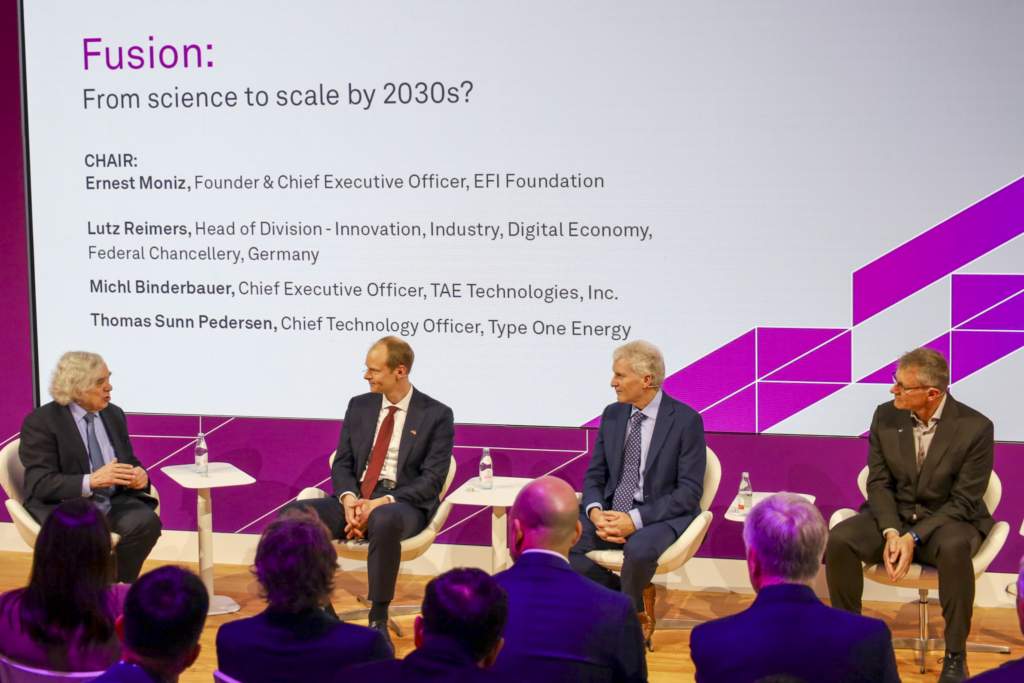
EFI Foundation Founder and CEO Ernest J. Moniz moderated “Fusion: From Science to Scale by the 2030s?” a panel on how fusion energy is moving from research to commercial deployment and what is needed to scale it. The panel included Type One Energy’s Thomas Sunn Pedersen, TAE Technologies’ Michl Binderbauer, and Lutz Reimers of the German Federal Chancellery.
Funding the Future: Innovation Strategies for a New Research Era
EFI Foundation Founder and CEO Ernest J. Moniz led the discussion at “Funding the Future: Innovation Strategies for a New Research Era,” alongside Mahdi Aladel of Aramco Ventures, Evelyn Wang from the Massachusetts Institute of Technology, and Jim Gable of Chevron. The panel focused on how to move energy innovations from research to deployment by strengthening collaboration, reducing risk, and improving feedback between sectors.
AI at Scale: Aligning Compute and Power Strategy
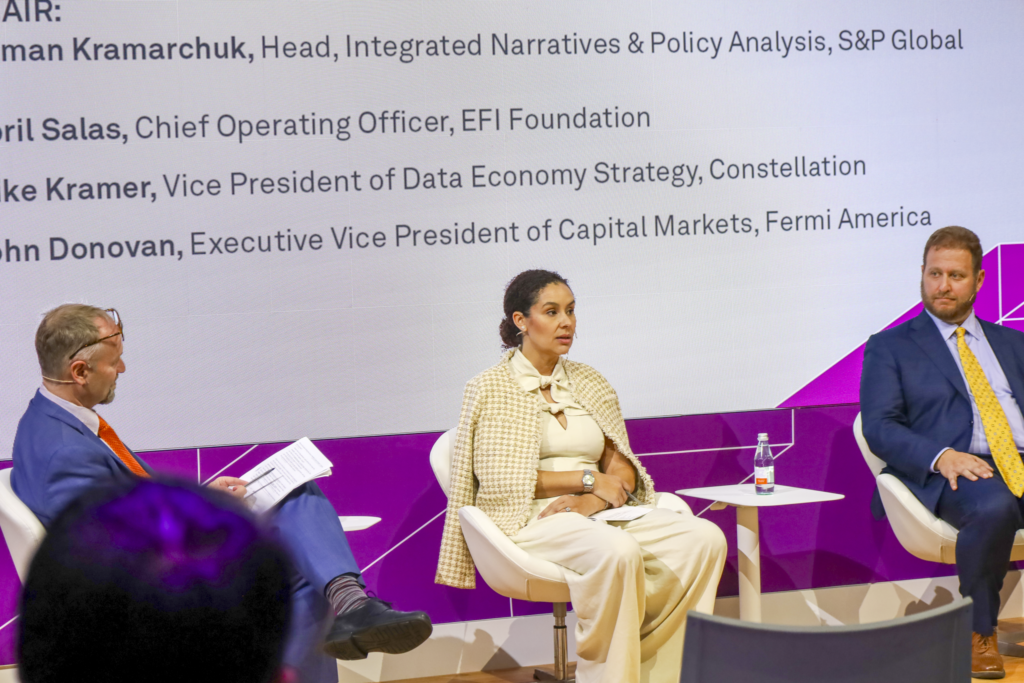
EFI Foundation Chief Operating Officer April Salas was joined by John Donovan of Fermi America, Roman Kramarchuk of S&P Global, and Mike Kramer of Constellation to discuss pathways to reliably supply more power to both the public and to AI compute. Siting and permitting continues to be an obstacle to meeting new energy demands; companies must engage with local communities to ensure projects go from paper to reality.
“I think there’s also opportunity in this load growth. And it’s not just AI data centers—it’s data centers, it’s industrial demand, it’s manufacturing. So we should take all of that into consideration as we’re looking for unexpected partnerships.” – April Salas
The Capital Stack for Climate and Energy: Where Philanthropy Now fits in a Changing World
Ernest J. Moniz’s discussion with Tom Taylor of the Bezos Earth Fund evaluated philanthropy’s evolving role in climate solutions. Tom highlighted that philanthropic organizations can take a long-term view, which lets them take more risks or accept a lower return on investment than governments can afford to do.
“The reality is, many major initiatives have started in the private sector with NGOs, philanthropies, et cetera.” – Ernest J. Moniz
Reimagining the Climate Strategy
The EFI Foundation’s Moniz joined a panel with Charlotte Wolff-Bye of PETRONAS, Fred Krupp of Environmental Defense Fund, James Wiemken of S&P Global, and Michael Greenstone of the University of Chicago to examine new approaches to familiar climate challenges. Greenstone emphasized that the response to climate change must happen quickly and broadly, stating that “sacred cows have got to go.”
“A problem has been that, when one looks at clean energy and climate, energy security, social equity—many of those conversations, almost all those conversations, are really held in silos.” – Ernest J. Moniz
Is AI Accelerating Development of Energy Technologies?
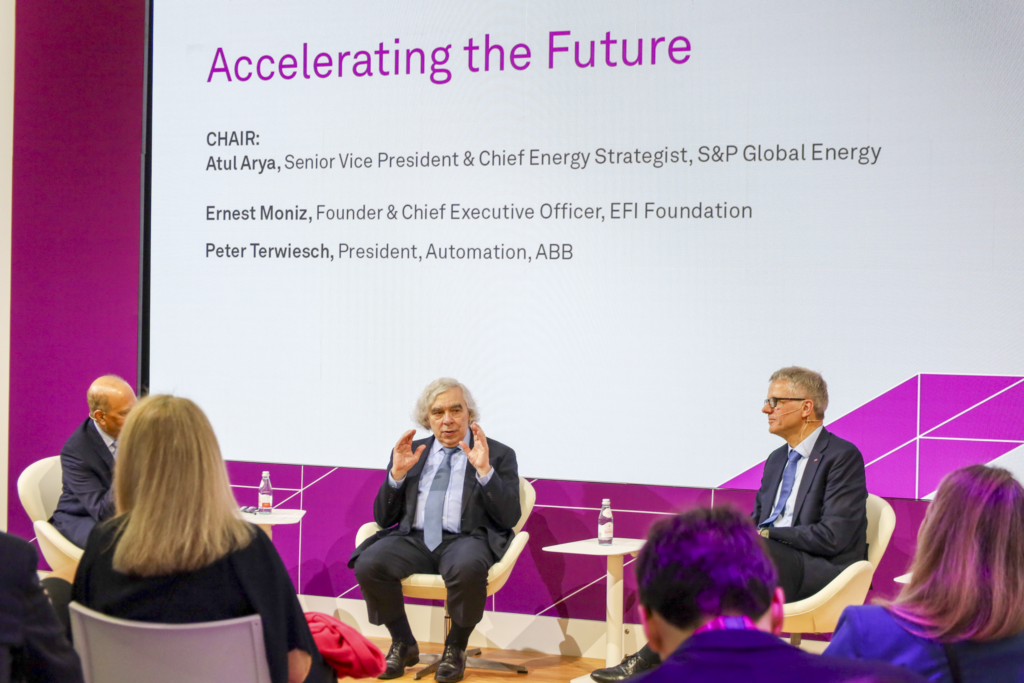
Moniz joined a session with Arun Majumdar of the Stanford Doerr School of Sustainability, Astrid Poupart-Lafarge of AVEVA Software, Atul Arya of S&P Global, and Pratima Rangarajan of Climate Investment, to assess how AI can make the energy system more secure, reliable, and sustainable. In addition to being a massive power consumer, AI also has the potential to solve complex, intractable energy problems. Machine learning could improve how the grid operates, unlocking enhanced reliability, better handling of load changes, and overall efficiency gains.
“In this period of change, this is a time when these emergent technologies, AI, may be foremost among them … give us the opportunity, I think, to capture the moment.” – Ernest J. Moniz
Energy Futures: The Pragmatic Path Forward
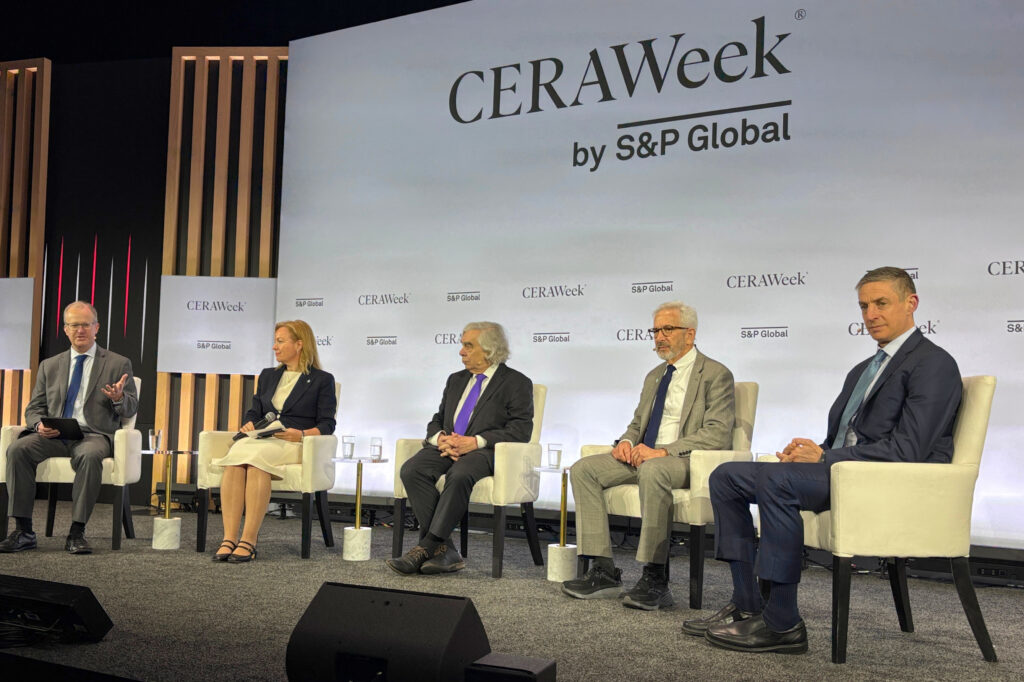
Ernest J. Moniz joined Atul Arya, Scott Tinker, and John Kerry for the panel “Funding the Future: Innovation Strategies for a New Research Era.” The conversation explored how conflict in the Middle East is influencing global energy markets, and why a more pragmatic, all-of-the-above approach is essential to ensure energy security. Panelists emphasized the need to strengthen and scale markets for emerging clean technologies like advanced nuclear and geothermal by better aligning policy, investment, and innovation.
“The lesson is that going to low-carbon energy is part of energy security.” – Ernest J. Moniz
Photos