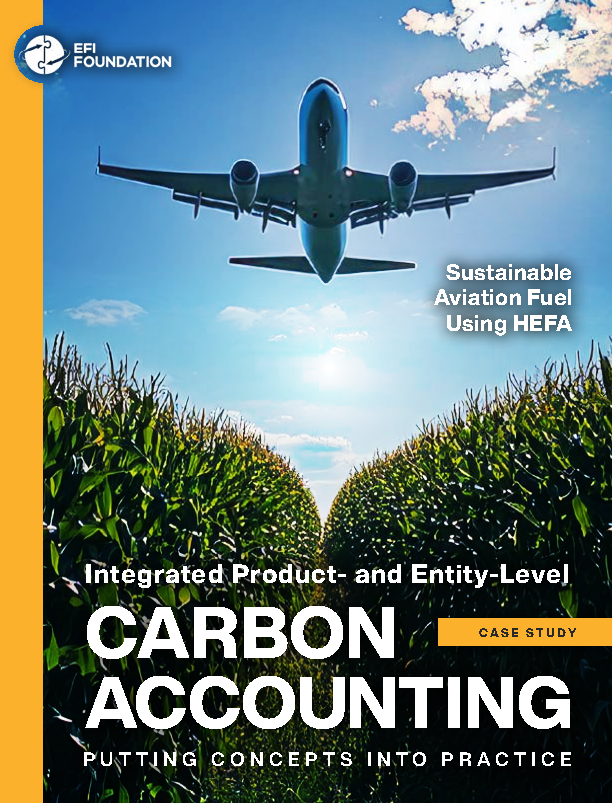
The Integrated Product- and Entity-Level Carbon Accounting Framework Case Study on Sustainable Aviation Fuel (Alcohol to Jet) (January 2026) is the second in a series of case studies designed to illustrate how a model comprehensive carbon dioxide (CO₂) emissions accounting system can be put into practice. This case study focuses on a sustainable aviation fuel (SAF) supply chain based on the alcohol-to-jet (AtJ) pathway, using a model SAF production facility sited in Great Falls, Montana.
The EFI Foundation’s October 2025 report, Integrated Product- and Entity-Level Carbon Accounting: Putting Concepts into Practice, described how a model carbon accounting system could be reduced to practice, using the production of SAF via the hydroprocessed esters and fatty acids (HEFA) process. This report provides a description of a case study examining an alternative pathway to SAF based on the use of ethanol feedstocks converted to SAF (alcohol to jet, or AtJ).
This SAF-AtJ case study is more complex than the SAF-HEFA case study. The SAF-AtJ pathway includes a supply chain that incorporates several additional decarbonization strategies, namely hydrogen production with carbon capture and sequestration (CCS) and the purchase of verified carbon removal credits from a third party. The study assumes five primary upstream suppliers: a natural gas supplier, an electric utility, an ethanol producer, a hydrogen producer using autothermal reforming (ATR) with CCS, and a provider of verified carbon removal credits. The resulting SAF is blended 50-50 with conventional jet fuel refined in the same region from Bakken crude oil and sold to a commercial airline customer.
The results of the case study are presented from three perspectives:
- The Engineer’s Perspective: The complete carbon mass and energy balances that provide the foundational data for the accounting ledger, including CO₂ emissions and physical carbon content over the three-month period of operations;
- The Accountant’s and Auditor’s Perspective: The CO₂ emissions accounting ledgers of the entities in the supply chain, providing the basis for all entity-level and product-level reports; and
- Management and Policymaker Perspectives: Reports of product CO₂ emissions intensity and total CO₂ emissions derived from the ledger data.
The results demonstrate that a model comprehensive CO₂ emissions accounting system enables complete, transparent, and decision-useful carbon reporting for both entities and products across complex supply chains operating beyond baseline conditions. Together with the first SAF via HEFA case study, this analysis demonstrates the comparability of carbon data produced using a ledger-based accounting approach. Product-level carbon intensities for SAF via AtJ, SAF via HEFA, and conventional jet fuel can be directly compared across supply chains and production pathways because all values are calculated using a consistent ledger-based methodology.
Read more from our carbon accounting work:
-
—
-
—
-
—
-
—
-
—
-
—