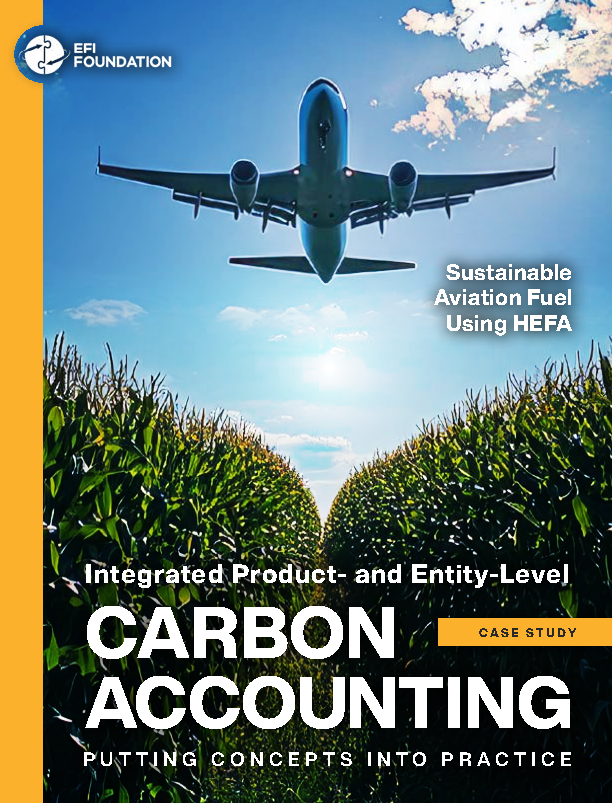
The Integrated Product- and Entity-Level Carbon Accounting Framework Case Study on Sustainable Aviation Fuel Using HEFA (January 2026) is the first in a series of case studies designed to illustrate how a model comprehensive carbon dioxide (CO₂) emissions accounting system can be applied to a sustainable aviation fuel (SAF) pathway using the hydroprocessed esters and fatty acid (HEFA) process.
The EFI Foundation’s October 2025 report, Integrated Product- and Entity-Level Carbon Accounting: Putting Concepts into Practice, presents a comprehensive CO₂ emissions accounting system that integrates principles of financial accounting with engineering fundamentals and introduces a SAF case study using the HEFA process to demonstrate the system in practice. This report provides a more detailed description of that case study.
The case study uses a hypothetical SAF supply chain based on a facility in Great Falls, Montana. The SAF product is combined with conventional jet fuel refined in the same region from Bakken crude oil to create a 50-50 blend that is sold to a commercial airline customer. The study develops detailed mass and energy balances for the hypothetical SAF supply chain, assuming three primary upstream suppliers: a natural gas supplier, an electric utility, and a soybean oil supplier. The SAF production facility converts these inputs into several hydrocarbon products through steam methane reforming and the HEFA process—namely SAF, naphtha, and liquefied petroleum gas (LPG). The SAF is transported by truck to a blending terminal, where it is blended with conventional jet fuel before being delivered via pipeline to a nearby airport.
The results of the case study are presented from three perspectives:
- The Engineer’s Perspective: The complete carbon mass and energy balances that provide the foundational data for the accounting ledger, including CO₂ emissions and physical carbon content over the three-month period of operations;
- The Accountant’s and Auditor’s Perspective: The CO₂ emissions accounting ledgers of the entities in the supply chain, providing the basis for all entity-level and product-level reports; and
- Management and Policymaker Perspectives: Reports of product CO₂ emissions intensity and total CO₂ emissions derived from the ledger data.
This case study demonstrates that a comprehensive CO₂ emissions accounting system enables complete, transparent, and decision-useful carbon reporting. For airline customers, product-level CO₂ intensity data supports strategic planning, marketing, and willingness-to-pay decisions for lower-carbon products. For SAF producers, product-level CO₂ intensity serves as a key performance indicator to identify and evaluate opportunities to reduce emissions through additional decarbonization strategies. The system also provides a complete record of total emissions, with no gaps in coverage, along with complete and transparent allocation of emissions among products. By recording CO₂ emissions once and transferring them from supplier ledgers through the SAF producer to the end customer, the system prevents double counting. Built-in validation checks support accuracy, while a complete and transparent audit trail enables third-party verification and ensures correct allocation of entity-level emissions across products.
Read more:
-
—
-
—
-
—
-
—
-
—
-
—